Support Wildlife Rehab: Intern with Us
Looking for wildlife experience for your career? Our GCWR Operations Internship program was designed as an intensive volunteer experience where you can gain valuable animal husbandry/caretaking experience while supporting our work in the rescue, rehabilitation, and release of wildlife.
We rescue thousands of wild animals each year, with our busiest season happening March through October, during baby wildlife season. During this time, we receive thousands of orphaned and injured newborn animals that have fallen from nests or been displaced from their parents. These babies require extensive and often long-term wildlife care.
Wildlife rehabilitation requires a lot of people power and a serious commitment to care for the hundreds of wild animals recovering at our center each day. Operations Interns assist GCWR wildlife technicians in the daily tasks at our Wildlife Intake Center (WIC) in Auburn, CA. Each animal requires daily enclosure cleaning, feeding, and observation; some even require these multiple times a day.
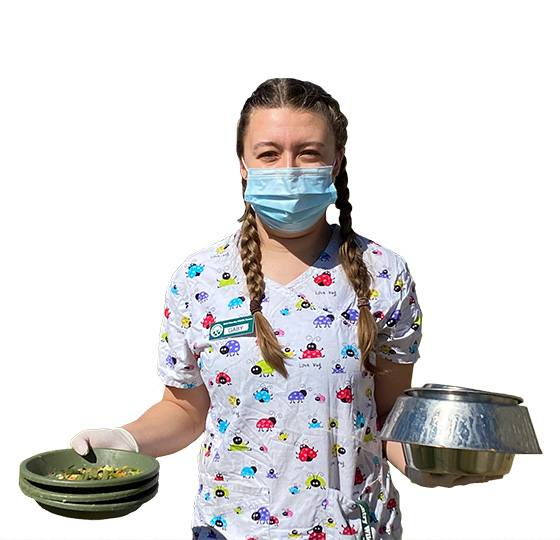
Therefore, our daily wildlife care tasks include, but are not limited to: sanitizing animal enclosures, washing lots of bedding, sanitizing feeding equipment, setting up new enclosures, preparing food for individual species, washing lots of food dishes, and helping keep the Wildlife Intake Center organized for maximum efficiency.
When you intern with GCWR, you’ll be gaining work experience, learning new skills & knowledge, building your resume, earning college credit (if applicable), and gaining an overall feel for the field of wildlife rescue & rehabilitation.
Required Commitment: Two 8-hour days per week, for a minimum of 12 weeks or 200 service hours (with the possibility to extend)
Internship Location: GCWR Wildlife Intake Center (WIC), 11251 B Ave., Auburn, CA 956033
Wildlife Experience You Gain
- Learn how wildlife are safely rescued, rehabilitated, and released
- Gain work experience in a fast-paced, wildlife rehabilitation service
- Learn how to safely enter enclosures, restrain and move wildlife, prepare diets for specific wildlife species
- See unique wildlife up close
- Learn safety procedures and policies for working around wildlife
- As time allows, our wildlife technicians allow you to observe medical examinations and treatments (such as physical therapy, feedings, wing wraps, and leg splints)
- Gain emotional growth – In wildlife rehabilitation, we’re responsible for saving many lives, however, no matter how well we do our job, some animals simply will not make it. Although a last resort, animals that are too sick or injured to be rehabilitated must be euthanized to reduce suffering. Working in wildlife rehabilitation, we learn to focus on what you can do and not what you can’t. You will gain an appreciation for a job well done, when you see an animal recovers and returns home wild. GCWR believes in keeping wildlife wild through the entire process of rescue, rehabilitation, and release. Allowing these animals to successfully return to the wild with their natural skills intact. This is not an internship to apply for if you want to play with animals.
Operation Internship Requirements
- Must be at least 18 years of age.
- Must serve at least 16 hours per week (two 8-hour days), completing a minimum of 200 hours (usually completed in three months).
- Spring/Summer intern shift hours – 7am-7pm, 8 hour shifts, with 1-hour lunch break
- Must arrive on time to your scheduled shifts. Interns are expected to arrive on time for their scheduled shifts. Consistent attendance and punctuality are essential to ensure continuity of care to our patients.
- Must be able to stand for extended periods of time (up to three hours), able to lift at least 25 lbs, and complete a variety of physically demanding tasks in a fast-paced environment.
- Must be able to follow verbal and written directions by staff and board members. Interns must have the ability and willingness to follow rules, regulations, policies, and procedures laid out by the GCWR organization. Failure to follow protocols and instructions will not be tolerated.
- Have a strong level of enthusiasm and desire to learn. Daily wildlife care tasks can be repetitive, but there is more to learn every day as new intakes constantly arrive. Interns are expected to become proficient in dozens of tasks.
- Must be detail oriented. Interns are often responsible for watching animal behaviors and must report changes or odd behavior of animals to staff immediately. Interns must be aware of enclosure set-ups and confirm proper materials are available on a species specific level.
- Must be a team player and self-starter as interns will work in groups, teams, and independently with limited supervision.
- Prior to beginning the internship, participants are required to complete program-specific requirements, including paperwork and waivers.
Desired Qualifications
- Currently enrolled in, recently graduated from, or pursuing animal related degree.
- Previous work/volunteer experience with wildlife or domestic animals through vet clinics, zoos or other rehabilitation centers.
- Interns who provide documentation of current rabies vaccination status and an acceptable rabies antibody titer level (if vaccination is more than 2 years old) may be considered for work with rabies vector species (e.g., raccoons, foxes, and coyotes) based on program needs, performance evaluation, and supervision.
What this internship is NOT:
- NOT a place to play, hold, or cuddle animals
- NOT a paid internship
- NOT able to provide housing or transportation
- NOT for people unable to commit to the required times/shifts needed. Our internships roles are critical and scheduled weekly to complete specific daily animal care tasks. Failure to arrive on time or missing shifts disrupts our level of wildlife care.
Operations Internship Duties
Wildlife Diets & Food Prep: Interns will be responsible for making and distributing liquid and solid foods for all species of wildlife that comes through the WIC for care. Examples of food prep include mixing appropriate seed dishes, offering and caring for mealworms, handling frozen mice & fish, cleaning and distributing appropriate fruits, vegetables and other miscellaneous diet ingredients. Not all ingredients are listed.
ATTENTION to persons with food allergies. Please be aware our animal diets may contain common allergens, such as eggs, wheat, nuts, peanuts, fish, grass. and hay. This is not a complete list of ingredients. Volunteers or Interns with allergies are advised to notify their volunteer supervisor to minimize risk and safely handle foods containing potential allergens.
Cleanliness and Maintenance: As an animal caretaker, Operations Interns (along with all staff and volunteers) are responsible for maintaining a clean working environment and ensuring our patients are kept in a clean habitat. Some examples of daily chores include laundry, washing dishes, sweeping floors, replacing enclosure liners, caring for lab equipment, and performing facility repairs.
Record Keeping: Interns are responsible for keeping accurate animal records on intake, medication, and feeding sheets. Intake sheets will keep up to date progress of an individual patient’s history in GCWR’s care. Medication sheets track an individual’s medication history. Such examples might include: pain management, parasite treatment, or infection treatment. Feeding sheets track an individual’s daily routine. From how often an enclosure is replenished with freshwater or additional food trays, to the exact amount of liquid food a specific animal is fed each hour over the course of that animal’s care at GCWR.
Hands-on experience: Interns will be expected to learn various animal handling and feeding techniques in order to care for wildlife patients properly. Physically handling these animals is a crucial part of this position but is never done without consideration and caution.
SPECIAL NOTE: Every wild animal that comes through our door is treated as wild, through rescue, rehabilitation, and release. Every animal care task performed on behalf of GCWR is done with the ultimate goal to keep injured and orphaned wildlife wild. The wilder an animal is when they leave our center the better chances they have of surviving. Therefore, at GCWR, we limit human exposure by NOT “cuddling” wildlife, NOT speaking around them, and NO unnecessary handling.
Application Process
- Applications for our Spring/Summer Internship Program are accepted from January through April and are subject to limited availability. For additional information or to request an application, please email volunteercoordinator@goldcountrywildliferescue.org.
Apply for GCWR’s Operations Internship
Interested in learning more about or applying for this internship opportunity? Send us an email!
ATTENTION to persons with food allergies. Please be aware our animal diets may contain common allergens, such as eggs, wheat, nuts, peanuts, fish, grass. and hay. This is not a complete list of ingredients. Volunteers or Interns with allergies are advised to notify their volunteer supervisor to minimize risk and safely handle foods containing potential allergens. After reviewing the information above, please notify us of any allergen concerns prior to applying.
Questions? Please contact volunteercoordinator@goldcountrywildliferescue.org